Dental Implants

sv-dt1

Dental Implants

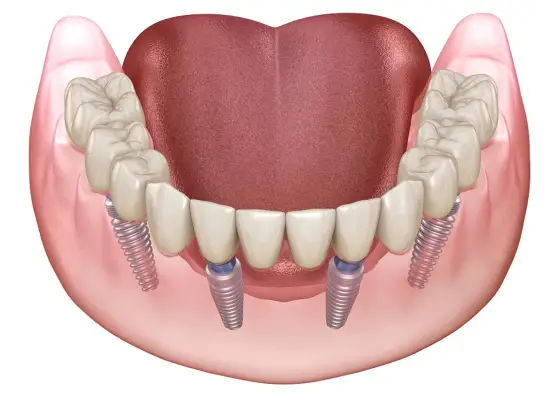
Dental implants are a type of restorative dentistry, which is an option for people who have lost teeth due to injuries or other dental problems that cannot be solved with conventional dentures and crowns. In some cases, an individual may require morethan one implant to restore their bright smile.

Fixing the jawbone may become an important part of this treatment at times because it ensures the quality and strength of the implants if they are installed in areas where there is bone loss.

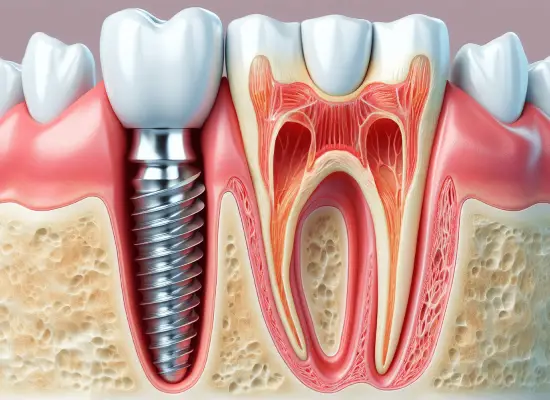
Dental implants are unnatural tooth roots that are surgically implanted into the jawbone. Teeth implants act as a base for securing a prosthetic tooth in place. They function similarly to natural tooth roots in this regard. As a result, artificial teeth that look, feel, and function exactly like natural teeth are created.

Dental Implants Procedure:

This dental procedure is carried out in the dentist's office under local anaesthesia. To make the procedure go more smoothly, those who are nervous about the procedure can be given a sedative medication. Your dental professional will advise you based on the number of implants that will be placed in your mouth and the difficulty of the surgery.
The oral surgeon first cuts the gum to reveal the bone, then drills a hole into which the titanium screw will be inserted. After that, the metal post is screwed in place. Following that, the gum tissue will be joined to cover the implant after it has been placed to prevent food from becoming lodged in the gum.
The healing process would take four to six months. During this time, the implant ultimately attaches to the bone through a process known as osseointegration.

The Abutment Installation

The abutment is attached after the implant has been fully integrated. It joins the replacement tooth, also known as the implant crown, to the implant.
To place the abutment, minor surgery to open up the gums is required. It is a simple outpatient procedure that requires only a local anaesthetic. Once the abutment is in place, the gum tissue will close around it but not completely cover it.
There are still cases where both the implant and the abutment are placed during the same surgery. Long-term negative symptoms are generally not observed in the person being treated as long as the gums have enough time to heal.
Your dentist may recommend a temporary crown for your teeth. They heal at the same time to avoid the discomfort of the metal post protruding from the gums.
Furthermore, the recovery time lasts about two weeks. It would be the final stage of the oral surgery, as the porcelain crown would be fitted next.

Crown Fitting

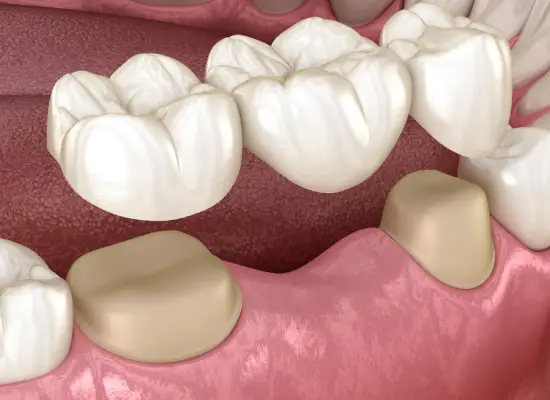
Your surgeon will shape the substitute tooth to fit your existing tooth structure after taking new dental impressions.
After the swelling in your mouth has subsided, you will return to your dentist for the new crown. The first step is for them to take impressions of your mouth, which they will use to create the fabricated tooth that will be attached to the abutment.
People who want to maintain a natural appearance may choose the same colour for their crown as the rest of their natural teeth. Others, on the other hand, may prefer a flashier appearance with permanent gold teeth.

Dental implants are a delicate process and procedure. Understanding the steps, let alone knowing where to go for care if you need an implant or are considering implants in your practise, can be difficult.

{01}

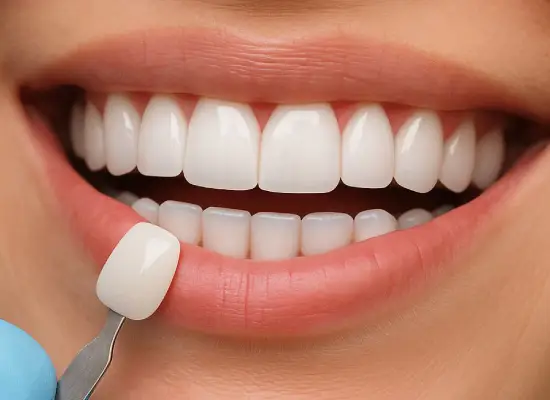
Smile Designing

For our patients with impairments resultiom from injury affectiong the system.
{02}

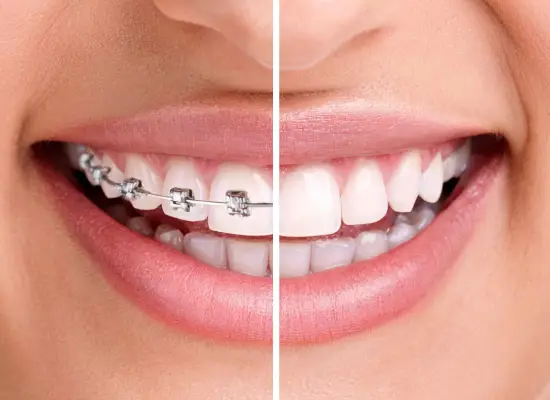
Dental Braces

For our patients with impairments resultiom from injury affectiong the system.